


ChangeMakers Reputation Index Reveals the Impact of Change Events on Corporate Reputation
Washington, DC, January 28, 2025 —The inaugural ChangeMakers Reputation Index highlights the powerful connection between change events and corporate reputation, uncovering the significant positive and negative impacts of how change is managed. The annual analysis examines 25 companies experiencing five types of change events, both planned and unplanned, and finds that immediacy – both of communication and strategy when a pivot is required – plays a critical role in shaping long-term reputational outcomes. Companies that handle change effectively often bolster their reputation, while those that falter under pressure risk substantial harm.
“In today’s environment, the highest value driver for any organization or individual is reputation,” says Mario Simon, CEO of ChangeMakers. “Preparing for, responding to, recovering from, and even harnessing significant change events is a top priority for any company. This exciting research clearly demonstrates how reputational impacts can and should be managed. Poorly communicated or delayed responses to change events can leave significant value on the table and, in extreme cases, be financially devastating. We have cracked the quantifiable code to manage that for our clients and achieve the best outcomes.”
Importantly, the study revealed that planned business changes—such as seemingly innocuous events such as brand changes and leadership transitions—can have reputational risks as significant as those stemming from unexpected crises.
Key Findings:
- Merger & Acquisition Transactions: While mergers and acquisitions often deliver a short-term boost to a company’s reputation, this positive impact tends to fade quickly among stakeholders not directly involved or affected.
- Brand Change: Contrary to expectations, brand changes frequently lead to both immediate and long-term damage to reputation. This is often a result of missteps in communication strategy, undermining the intended positive outcomes.
- Financial Change: Financial changes produce mixed reputational effects, with positive or negative impacts typically short-lived. However, significant mismanagement can exacerbate negative perceptions. Notably, the absence of proactive, targeted communication with key audiences often results in muted or underwhelming reputational outcomes, even when changes are objectively positive.
- Leadership Transition: The reputational effects of leadership transitions hinge significantly on whether the departure is planned or unplanned. How the transition is communicated and managed plays a critical role in shaping public perception.
- Public Crisis: The reputational impact of a public crisis is highly contingent on preparation and the company’s ability to respond swiftly and effectively. Organizations that demonstrate readiness and transparency are better positioned to mitigate both immediate and long-term damage.
The ChangeMakers Reputation Index establishes the new industry benchmark for measuring how companies navigate change events and underscores the importance of proactive reputation management. It is powered by the proprietary ChangeMakers Reputation Score©, which uses a wide range of sources to determine a numeric measurement of reputation in near real-time.
To explore the full findings and gain actionable insights from the study, download the report at https://thechangemakers.com/us/reputation-index-2024/.
About ChangeMakers:
ChangeMakers is a 400+ person independent reputation management, social impact and marketing firm with offices throughout North America. ChangeMakers combines deep business specialization with human-centered strategies, working alongside our clients to strengthen their reputation and succeed in a disruptive world.
About ChangeMakers Reputation Index:
It is the most extensive review of impact to corporate and organizational reputation before, during, and after significant change events. Depending on the circumstance, reputation-altering events can be planned, unexpected, or both. This is the inaugural release of this important research driven by the ChangeMakers Reputation Score©, a unique and proprietary tool that measures brand’s reputation in real-time—mainly when the stakes are high. It analyzes data sources beyond the digital and social media space to include the most important factors to corporate executives and boards. Organizations are chosen based on our independent analysis of publicly available sources, such as industry rankings, financial reporting and market intelligence, while also seeking sector diversity.


Media Contact:
Caroline DeSilva /Senior Vice President, ChangeMakers
caroline.desilva@thechangemakers.com
Why reputation is one of your most valuable (and fragile) assets

Brand is the promise an organization makes to its audiences. Reputation is how well an organization keeps that promise.
We say this to clients all the time. But there’s a third concept, the most important of all, that every organization wants but not all of them have: Trust.
Trust is what an organization earns (or loses) as a result of that promise and how well it’s kept.
How do these three concepts interact?
We think of trust as a bridge between brand and reputation. It’s built slowly over many years, even decades, through consistency, quality, and earned reputation. When what an organization promises and what it delivers are aligned, the bridge holds. But what takes years to build can collapse in a matter of seconds.
And yet, many organizations still rely on instinct rather than data to tell them whether that bridge is holding.
How trust is actually built (and why it’s so hard to do)
Every organization wants to be a trusted brand. They invest in building their brand and managing their reputation, assuming that if those two things are strong, trust will naturally follow. But it doesn’t work quite like that.
Brand and reputation create the conditions for trust, but they don’t guarantee it. Brand is something you build and reputation is something you manage; but trust, that is something your audience decides.
You can’t control trust directly, but that doesn’t mean you can afford to ignore how it is built or lost. To understand why, it helps to think about how trust forms at the most human level, and why organizations can’t replicate it the same way.
With a person, trust is all about the relationship. Your interactions are personal, contextual, and forgiving: a trusted friend can have a bad day without significant consequences. In a brand context, whether it’s a company, public institution, government, or platform, external people rarely have access to decision makers in an organization. When intent isn’t visible, trust gets built through signals: what organizations say, how they act, policies, other people’s experiences, press coverage, delivery on their brand promise, and even who endorses them can all have impact.
This is the challenge: trust has to be earned and built over time. And because institutional trust is built on foundations an organization can’t fully control, everything can be done correctly and you’re still one bad weekend away from watching that bridge collapse.
Reputation is more fragile than most brands assume
Reputation can rupture in a split second. Some audiences are more forgiving than others, but history has taught us that pressure builds quietly, until a single decision, message, video or event undoes years of bridge-building.
Reputation rupture event: a triggering moment that occurs when accumulated pressure on an organization’s credibility is suddenly exposed. In other words, when the bridge collapses.
Today, these events can spread in seconds thanks to screenshots, reposts, X messages, Reddit communities, and un-trackable text messages. Social media has given audiences a plethora of platforms, and the motivation to speak up — sometimes anonymously, sometimes personally — faster than any communications team can respond. This turns into a bigger risk if that person has a considerable following of their own.
This is why monitoring and tracking brand reputation and online presence is fundamental. And now, in an AI-driven environment, that job is more urgent and complex. This is not just social media listening or sentiment tracking. Most brands are measuring what’s loud, while pressure points are building tension over time. These pressure points are embedded across operations, employee experience, stakeholder trust and public perception, which are areas traditional monitoring usually overlooks.
The warning signs are often subtle. Repeated complaints not escalated or employee reviews not addressed can cause small gaps between the brand promise and how well it’s maintained. Moments might seem isolated but point to something deeper. When tracked collectively, these signals begin to reveal patterns of declining confidence and legitimacy, long before they show up in traditional metrics.
Reputation rupture events rarely come out of nowhere. In most cases, the pressure was visible, but wasn’t recognized. This is becoming a more prominent risk in an AI-driven world, with decisions amplified and interpreted at scale.
In February 2026, two AI companies faced the same decision. One said no, one said yes. Both decisions were rooted in existing tensions around transparency, control and trust. The aftermath of those two events was a reputation rupture event that played out in real time.
Chat, why are they losing so many users? — OpenAI’s reputation rupture event
In early March 2026, the Pentagon labeled Anthropic “a supply chain risk, effective immediately1” — a label usually reserved for US adversaries, never before applied to a US company2 . The designation was blocked by a US judge in March 2026, then reinstated on appeal in April3. Anthropic is currently excluded from Department of War4 contracts while the litigation continues. They also designated Claude “a national security risk5” after Anthropic refused to remove restrictions on two specific uses: mass domestic surveillance and fully autonomous weapons. The Department of War demanded the right to use Claude “for all lawful purposes6” without exception.
The US government making that designation should have been enough to cause a reputation rupture event and inflict massive damage to Anthropic’s reputation … but it wasn’t.
The reason? Anthropic’s response to these requests. On February 26th, Anthropic CEO Dario Amodei published a statement pushing back on the DOW’s requests. Anthropic stood by their principles and didn’t budge. Many users online praised this decision, but the story wasn’t over.
Hours later, OpenAI CEO Sam Altman published on X that his company had finalized a deal with the DOD to deploy models in the DOD’s classified network. That single message ignited a rupture event:
- ChatGPT uninstalls jumped 295%7 within 24 hours.
- One-star app reviews surged 775%8 the same day.
- A Reddit post urging ChatGPT cancellation hit 30,000 upvotes9 before the weekend ended.
- The QuitGPT movement gathered over 4 million10 digital participants and organized a physical protest outside OpenAI’s San Francisco HQ.
- Claude topped the App store’s download11 charts.
Same DOD contract, same weekend, opposite decisions, completely different trust outcomes. And yes, after the fact, OpenAI said that they were rushed, and that they were working on the terms and conditions, that the deal “looked opportunistic and sloppy”. But the reputation damage was done: trust was broken.
We used our proprietary brand health measurement tool, ChangeMakers RepScore© to measure the impact in real time. Our Data Intelligence team identified a 34.3 point drop12 from OpenAI’s baseline within a single day. This volume of movement reflects how quickly reputation can rupture when expectations fall out of alignment. It appears sudden, but it’s usually the result of underlying pressures reaching a tipping point.
Uninstalls, reviews, and protest movements are lagging indicators: they tell you the bridge already collapsed. The backlash caused OpenAI to subsequently amend the deal to add surveillance restrictions, which is the real evidence: the reputation rupture event forced a course correction, proving the trust damage was real enough to change corporate behaviour.
The question for any organization is: do you have a way to predict and measure the damage in real time, and do you have a baseline to measure it against?
What keeps the bridge standing
Most organizations treat trust as a sentiment; something they feel is in good shape until suddenly it isn’t. But the organizations that protect it effectively aren’t reacting to crises; they’re tracking the pressure points to avoid a brand reputation collapse.
Understanding how your reputation is perceived (and where the gaps between your promise and your audience’s experience might be growing) is what keeps the bridge standing. These gaps are early indicators of trust erosion that can impact everything from customer behaviour to employee retention. It’s why we built the Reputation Score©: to give organizations a measurable read on the health of their brand reputation before it becomes a crisis, grounded in verifiable and relevant data points.
When reputation is measured consistently, it becomes something brands can actively track. Knowing your Reputation Score© helps you respond to risk with intention instead of reacting under pressure, and spot opportunities to build trust proactively.
A brand promise has little value if audiences do not trust it.
In a world where a single decision can destroy years of earned reputation, treating trust as a passive outcome is no longer a strategy any organization can afford.
Why reputation is one of your most valuable (and fragile) assets

Brand is the promise an organization makes to its audiences. Reputation is how well an organization keeps that promise.
We say this to clients all the time. But there’s a third concept, the most important of all, that every organization wants but not all of them have: Trust.
Trust is what an organization earns (or loses) as a result of that promise and how well it’s kept.
How do these three concepts interact?
We think of trust as a bridge between brand and reputation. It’s built slowly over many years, even decades, through consistency, quality, and earned reputation. When what an organization promises and what it delivers are aligned, the bridge holds. But what takes years to build can collapse in a matter of seconds.
And yet, many organizations still rely on instinct rather than data to tell them whether that bridge is holding.
How trust is actually built (and why it’s so hard to do)
Every organization wants to be a trusted brand. They invest in building their brand and managing their reputation, assuming that if those two things are strong, trust will naturally follow. But it doesn’t work quite like that.
Brand and reputation create the conditions for trust, but they don’t guarantee it. Brand is something you build and reputation is something you manage; but trust, that is something your audience decides.
You can’t control trust directly, but that doesn’t mean you can afford to ignore how it is built or lost. To understand why, it helps to think about how trust forms at the most human level, and why organizations can’t replicate it the same way.
With a person, trust is all about the relationship. Your interactions are personal, contextual, and forgiving: a trusted friend can have a bad day without significant consequences. In a brand context, whether it’s a company, public institution, government, or platform, external people rarely have access to decision makers in an organization. When intent isn’t visible, trust gets built through signals: what organizations say, how they act, policies, other people’s experiences, press coverage, delivery on their brand promise, and even who endorses them can all have impact.
This is the challenge: trust has to be earned and built over time. And because institutional trust is built on foundations an organization can’t fully control, everything can be done correctly and you’re still one bad weekend away from watching that bridge collapse.
Reputation is more fragile than most brands assume
Reputation can rupture in a split second. Some audiences are more forgiving than others, but history has taught us that pressure builds quietly, until a single decision, message, video or event undoes years of bridge-building.
Reputation rupture event: a triggering moment that occurs when accumulated pressure on an organization’s credibility is suddenly exposed. In other words, when the bridge collapses.
Today, these events can spread in seconds thanks to screenshots, reposts, X messages, Reddit communities, and un-trackable text messages. Social media has given audiences a plethora of platforms, and the motivation to speak up — sometimes anonymously, sometimes personally — faster than any communications team can respond. This turns into a bigger risk if that person has a considerable following of their own.
This is why monitoring and tracking brand reputation and online presence is fundamental. And now, in an AI-driven environment, that job is more urgent and complex. This is not just social media listening or sentiment tracking. Most brands are measuring what’s loud, while pressure points are building tension over time. These pressure points are embedded across operations, employee experience, stakeholder trust and public perception, which are areas traditional monitoring usually overlooks.
The warning signs are often subtle. Repeated complaints not escalated or employee reviews not addressed can cause small gaps between the brand promise and how well it’s maintained. Moments might seem isolated but point to something deeper. When tracked collectively, these signals begin to reveal patterns of declining confidence and legitimacy, long before they show up in traditional metrics.
Reputation rupture events rarely come out of nowhere. In most cases, the pressure was visible, but wasn’t recognized. This is becoming a more prominent risk in an AI-driven world, with decisions amplified and interpreted at scale.
In February 2026, two AI companies faced the same decision. One said no, one said yes. Both decisions were rooted in existing tensions around transparency, control and trust. The aftermath of those two events was a reputation rupture event that played out in real time.
Chat, why are they losing so many users? — OpenAI’s reputation rupture event
In early March 2026, the Pentagon labeled Anthropic “a supply chain risk, effective immediately1” — a label usually reserved for US adversaries, never before applied to a US company2 . The designation was blocked by a US judge in March 2026, then reinstated on appeal in April3. Anthropic is currently excluded from Department of War4 contracts while the litigation continues. They also designated Claude “a national security risk5” after Anthropic refused to remove restrictions on two specific uses: mass domestic surveillance and fully autonomous weapons. The Department of War demanded the right to use Claude “for all lawful purposes6” without exception.
The US government making that designation should have been enough to cause a reputation rupture event and inflict massive damage to Anthropic’s reputation … but it wasn’t.
The reason? Anthropic’s response to these requests. On February 26th, Anthropic CEO Dario Amodei published a statement pushing back on the DOW’s requests. Anthropic stood by their principles and didn’t budge. Many users online praised this decision, but the story wasn’t over.
Hours later, OpenAI CEO Sam Altman published on X that his company had finalized a deal with the DOD to deploy models in the DOD’s classified network. That single message ignited a rupture event:
- ChatGPT uninstalls jumped 295%7 within 24 hours.
- One-star app reviews surged 775%8 the same day.
- A Reddit post urging ChatGPT cancellation hit 30,000 upvotes9 before the weekend ended.
- The QuitGPT movement gathered over 4 million10 digital participants and organized a physical protest outside OpenAI’s San Francisco HQ.
- Claude topped the App store’s download11 charts.
Same DOD contract, same weekend, opposite decisions, completely different trust outcomes. And yes, after the fact, OpenAI said that they were rushed, and that they were working on the terms and conditions, that the deal “looked opportunistic and sloppy”. But the reputation damage was done: trust was broken.
We used our proprietary brand health measurement tool, ChangeMakers RepScore™ to measure the impact in real time. Our Data Intelligence team identified a 34.3 point drop12 from OpenAI’s baseline within a single day. This volume of movement reflects how quickly reputation can rupture when expectations fall out of alignment. It appears sudden, but it’s usually the result of underlying pressures reaching a tipping point.
Uninstalls, reviews, and protest movements are lagging indicators: they tell you the bridge already collapsed. The backlash caused OpenAI to subsequently amend the deal to add surveillance restrictions, which is the real evidence: the reputation rupture event forced a course correction, proving the trust damage was real enough to change corporate behaviour.
The question for any organization is: do you have a way to predict and measure the damage in real time, and do you have a baseline to measure it against?
What keeps the bridge standing
Most organizations treat trust as a sentiment; something they feel is in good shape until suddenly it isn’t. But the organizations that protect it effectively aren’t reacting to crises; they’re tracking the pressure points to avoid a brand reputation collapse.
Understanding how your reputation is perceived (and where the gaps between your promise and your audience’s experience might be growing) is what keeps the bridge standing. These gaps are early indicators of trust erosion that can impact everything from customer behaviour to employee retention. It’s why we built RepScore™: to give organizations a measurable read on the health of their brand reputation before it becomes a crisis, grounded in verifiable and relevant data points.
When reputation is measured consistently, it becomes something brands can actively track. Knowing your reputation score helps you respond to risk with intention instead of reacting under pressure, and spot opportunities to build trust proactively.
A brand promise has little value if audiences do not trust it.
In a world where a single decision can destroy years of earned reputation, treating trust as a passive outcome is no longer a strategy any organization can afford.
Reputation Score© helps organizations build resiliency amidst imminent US-Canada tariffs
Built on a history of peaceful trade, defense and diplomacy, Canada and the United States have shared one of the world’s most interdependent economic relationships since the early 20th century.
A storied united front, the two countries boast the world’s longest undefended border and exchange nearly two billion dollars in goods and services daily.
In recent weeks, these longstanding bilateral ties have been tested. Unprecedented trade turbulence from the Oval Office, with the threat of tariffs (and temporary reprieves) on Canada and Mexico, have set off a chain of panic across North America.
While it may feel impossible to plan as an organization amidst evolving timelines, we’ve developed communications and crisis-preparedness strategies, rooted in real-time data, to prepare for what could lie ahead in this climate of economic unrest.
To better understand the impact of these tensions and inform recommendations, our Data Intelligence team applied the ChangeMakers’ proprietary Reputation Score©, drawing insights from the fall-out around this conflict. Tracking the fluctuation in trends, habits, audience sentiment, and key developments in consumer behaviour, we examined the reputational outlook of key sectors in the three-week window following the initial tariff declarations.
Here’s what you need to know about the reputational industry shifts, consumer reactions, and key strategies to prepare for what could lay ahead.
Cross-Border Reputation: The Power of Perception
As expected, both countries experienced a notable dip reputationally following the announcement of tariffs.
While Reputation Score allows brands, businesses, and executives to track their health and navigate reputation, we used this tool to understand how the threats of tariffs have impacted cross-border reputation from a geotargeted perspective.
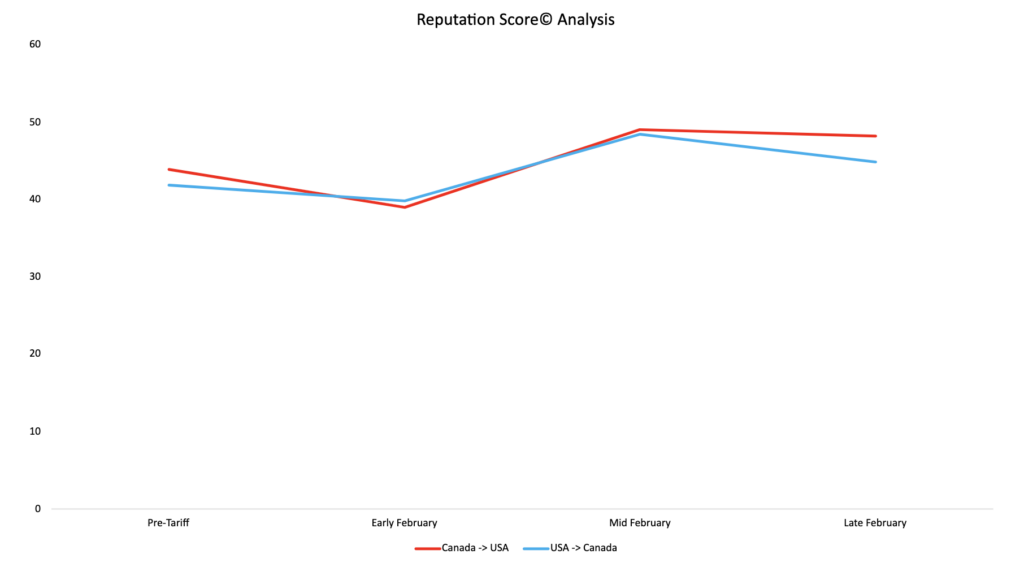
Digital conversations, particularly within pro-Trump communities, have fueled anti-Canada sentiment, while anti-tariff discussions have largely focused on Trump himself rather than offering support for Canada. This demonstrates how trade disputes quickly become emotionally charged, influencing how businesses and brands are perceived.
Industry Impact: Key Sectors in Focus
Despite a brief recovery during the 30-day reprieve, several industries have been hit reputationally as a result of the tariffs discourse. In examining the sector-specific impact, actionable strategies can be implemented by businesses within these spaces to mitigate for further risk.
With heightened consumer anxiety, organizations must be proactive in developing communications and operational strategies that shape their narratives and prepare for potential backlash in an unpredictable policy environment.
Consumer, Lifestyle & Tourism
The initial tariff threat, coupled with uncertainty about its duration, has fuelled a surge in “buy local” rhetoric in Canada. Prime Minister Trudeau’s call for domestic vacations spurred a 150% increase in searches related to Canadian vacations. Similarly, Google search data shows a significant spike in “Made in Canada” queries leading up to the tariffs.

While Canadian consumers may express loyalty to domestic brands, North America’s deeply integrated supply chain makes complete economic independence unrealistic. Businesses should expect continued emotional rhetoric but prepare for practical consumer behavior that blends patriotism with necessity.
Actionable Strategies:
- Establish a clear brand narrative to navigate consumer sentiment.
- Scenario plan for potential tariff-related price shifts.
- Monitor online discourse and adapt marketing strategies accordingly.
Agriculture
Canada and the U.S. have long relied on each other for agricultural trade, but tariffs have sparked discussions about reducing dependence on American imports. February saw a 575% increase in social media mentions of buying Canadian agricultural goods, signalling a shift in public sentiment.

Political rhetoric around Canada’s supply-managed sectors is also naturally intensifying. Businesses should explore new trade partnerships if possible, while strengthening domestic production.
Actionable Strategies:
- Diversify supply chains when possible, to mitigate reliance on U.S. markets.
- Amplify real-world stories about tariff impacts to foster industry advocacy.
- Stay attuned to political developments that could shape future trade policies.
Energy
Canada’s oil and gas sector, responsible for over 60% of U.S. energy imports, faces a 10% tariff as of February 27, threatening price stability and supply chain reliability. For Canadian oil producers, this would represent a nearly US$7-billion hit to their profit. Negative sentiment around Canadian energy exports has spiked, with unfavourable opinions outpacing positive ones by a ratio of 5.5:1.

As tariffs exacerbate uncertainty, the sector may see renewed calls for energy diversification, increased domestic investment, and stronger regulatory support for green energy initiatives.
Actionable Strategies:
- Explore alternative energy markets and partnerships, when possible.
- Identify champions who can advocate for industry stability.
- Align with public sentiment by investing in energy efficiency and sustainability.
Tech & AI
Hard tech goods moving across the border would be directly impacted by prospective tariffs, while AI and digital services remain vulnerable to broader geopolitical tensions. The AI arms race is becoming a critical point of cooperation, with both nations keen on outpacing China’s advancements.
Given the sector’s rapid evolution, businesses must approach AI policy with strategic foresight, ensuring alignment between corporate values and technological adoption.

Actionable Strategies:
- Develop a robust AI policy that integrates security and compliance.
- Stay ahead of government regulations that may impact AI and cloud services.
- Monitor geopolitical trends to anticipate shifts in the digital economy.
Automotive & Transportation
No industry is more vulnerable than North America’s auto sector, where just-in-time supply chains depend on frequent cross-border movement of parts. While tariffs threaten efficiency, public discourse remains surprisingly muted—only 10% of trade-related conversations focus on the auto industry, suggesting that consumers are more concerned with direct consumer goods price increases.

Actionable Strategies:
- Strengthen advocacy efforts to highlight the sector’s economic impact.
- Develop contingency plans for potential supply chain disruptions.
- Align internal teams across legal, government relations, and communications.
Preparing for What’s Next
As the trade pendulum continues to swing and timing remains uncertain, here’s how to stay ahead:
- Anticipate long-term changes: The tariff debate is fluid, but consumer sentiment and economic behavior will have lasting effects. Expect stakeholders to be driven by the emotion of the situation and communicate accordingly.
- Stay agile: The ability to pivot quickly in response to new developments will be crucial for business survival.
- Engage in digital advocacy: The online environment is ripe for brands to take a stance and rally support in a strategic, measured way. Create opportunities for your leaders & advocates to champion industry-wide causes.
Amidst this volatile time, organizations must be proactive, adaptable, and ready to engage with the evolving trade landscape. Through strategic communications, supply chain diversification, and targeted advocacy, now is the time to take decisive action.
About the Authors
Kenny Cameron / Senior Account Manager, Data Intelligence
With over five years of experience in public relations and data analytics, Kenny is an expert in reputation risk management and data-driven communications. Leading ChangeMaker’s Data Intelligence team in Canada, Kenny takes a client-focused approach to social listening and analysis that culminates in actionable takeaways to tackle complex communication challenges.
Rachel Cohen / Senior Account Manager, Reputation Management
With a passion for relationship-building and storytelling, Rachel is a trusted communicator, supporting clients through effective reputation management, crisis preparedness and brand strategy. Joining ChangeMakers with roots in the social-change space, Rachel thoughtfully advises and trains partners from a cross-border perspective on the evolving communications, as well as media landscapes in both countries.

Reputation Index 2024
For 2024, we assess the reputation impact on 25 major brands across five high-profile change trigger events, both planned and unexpected.
- M&A Transaction (Planned)
- Brand Change (Planned)
- Financial Change (Planned/Unexpected)
- Leadership Transition (Planned/Unexpected)
- Public Crisis (Unexpected)
Using the technology of our proprietary Reputation Score we analyze how organizations navigate these moments of change – before, during, and after events unfold.
Highlights of the index include:
- A major global fashion retailer’s impressive recovery after a public crisis event.
- Why two similar brand changes produce strikingly different outcomes.
- Surprising misalignment between financial shifts and brand reputations.
- The critical role of proactive communication during leadership transitions.
- Lingering power of legacy in M&A transactions.
Dive into ChangeMakers’ Reputation Index 2024 to uncover how major events impact brand reputation and learn what it takes to protect your biggest corporate asset. Your reputation.
In this age of disruption, change is the only constant. It is critical in this complex, competitive environment, for brands, businesses, and executives to know exactly where they stand.
Navigate your corporate reputation in real-time.
ChangeMakers Reputation Score© technology assess your organization, analyzes how competitors compare, predict reputational risks in advance, and creates opportunities for future growth.

Argyle becomes ChangeMakers: A bold new brand for modern corporate affairs

WASHINGTON, DC, October 29, 2024 — Believeco:Partners, along with its individual operating brands Argyle, Believeco and Castlemain, today is unveiling a new strategic direction, vision, and brand: ChangeMakers. This brand transformation reflects the company’s commitment to anticipating and navigating today’s complex corporate landscape, and the ever-evolving risks organizations face.
“The past two years have seen tremendous growth in our business, surfacing a unifying thread of unparalleled expertise in helping clients anticipate, navigate and create change,” says Mario Simon, CEO, ChangeMakers. “ChangeMakers takes these opportunities to the next level, embracing the challenges that complexity entails for our clients. We apply thoughtful, human-centered strategies designed for client success.”
The evolution follows two years of successful integration efforts, after Believeco:Partners formed with a bold agenda to unite six leading communications, marketing, and Indigenous advisory firms in the Fall of 2022.
“Reputation management will always be at the core of our work,” said Robert Gemmill, President, ChangeMakers USA. “And ChangeMakers best captures how our approach is different from most agencies: instead of relying on gut instinct, we use proprietary tools and approaches firmly rooted in data to inform decision-making on some of the most complex reputational challenges and opportunities facing clients today.”
By combining decades of experience in reputation management, social impact consulting and marketing, our team of ChangeMakers is an essential partner in driving client results – especially in complex spaces where the solution requires a modernized approach, backed by data intelligence and niche expertise. Our specialized work across healthcare, education, technology, energy and government makes us the ideal partner in addressing multi-stakeholder problems.
“The corporate world is shaping and shifting at an unprecedented pace, presenting new challenges and opportunities every day,” added Simon. “ChangeMakers is prepared to meet these challenges head-on, working alongside our clients to navigate both planned and unplanned change.”
About ChangeMakers:
ChangeMakers is a 400+ person independent reputation management, social impact and marketing firm based in the US and Canada. ChangeMakers combines deep business specialization with human-centred strategies, working alongside our clients to succeed in a disruptive world.
Learn more at www.thechangemakers.com.


Media Contact:
Robert Gemmill/President, US, ChangeMakers
robert.gemmill@thechangemakers.com
International Communications Veteran Jorge Ortega Joins ChangeMakers USA as Executive Vice President, Client Success
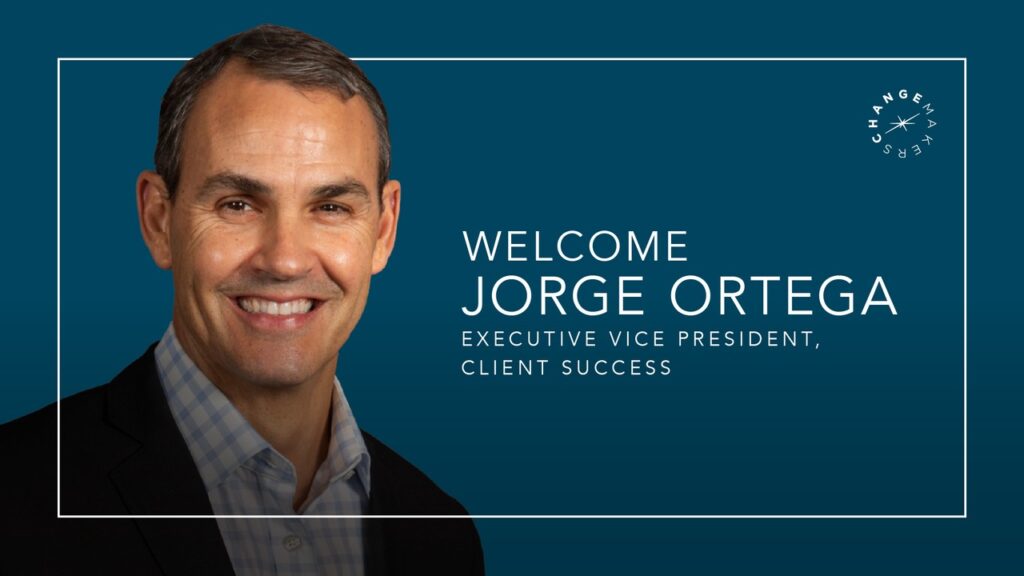
WASHINGTON, D.C. (April 10, 2025) — ChangeMakers, a leading North American communications and marketing firm focused on reputation and social impact, has appointed Jorge Ortega as Executive Vice President, Client Success and a member of the firm’s U.S. leadership team.
A former senior leader at two multinational agencies, Ortega brings decades of experience advising public and private sector clients on CEO communications, leadership development, brand strategy, and crisis response. He will report to Robert Gemmill, President of ChangeMakers, USA.
“Jorge is a major addition to the ChangeMakers team,” Gemmill said. “The trust he has earned from C-suite executives is evident by his deep relationships and broad experience across sectors. His leadership will be key as we grow our U.S. business and deliver the results our partners expect.”
Ortega joins ChangeMakers from CRA | Admired Leadership, where he served as Managing Director. He previously led Edelman’s southwest region and held senior roles at Burson. His career spans reputation strategy, brand communications, and high-stakes crisis response.
“Jorge’s appointment reflects our commitment to building a leadership team with both insight and impact,” said Mario Simon, CEO of ChangeMakers. “His integrity and experience align with our mission to navigate complexity for our clients.”
Ortega joins the ChangeMakers U.S. team, which specializes in helping clients anticipate and navigate complex, high-stakes communication situations. The firm uses its proprietary Reputation Score© AI platform to inform counsel and to measure and predict reputational impact in real time.
“I’m eager to bring my experience advising global clients to help ChangeMakers grow and deliver meaningful results,” Ortega said.
About ChangeMakers
For more than 40 years, ChangeMakers has helped organizations solve complex communications challenges by blending strategy, creativity, and insight. With more than 400 professionals across 10 locations in North America, we partner with clients to build stronger brands, navigate change, and drive meaningful impact. From corporate reputation and brand storytelling to social purpose and executive advisory, ChangeMakers brings together diverse expertise to help clients lead with confidence and clarity.
Stop Surviving Change. Start Operating Within It.

There was a time when change felt episodic — a system implementation, a reorganization, a strategic shift — distinct enough that organizations could prepare, execute, stabilize, and return to normal.
That time is gone and never coming back.
Today, change is a constant and multi-dimensional. Technology evolves, markets shift, leadership turns over, regulations move, and strategic priorities adjust — often all at once. By the time one initiative begins to settle, another is already competing for attention and resources.
In this environment, performance depends on more than managing individual initiatives well. Organizations have to rethink how their people understand change, make decisions, and execute under pressure. Volatility isn’t temporary anymore. So if change is constant, your operating model also has to reflect that new reality.
Five Change Realities
Here are five truths every organization must accept:
1. Change is Unavoidable and Must Be Normalized
Change can no longer be treated as a rare occurrence that surprises the team and eventually passes. Teams need to anticipate change as part of how they operate. This means shifting the mindset from “we’re going through change” to “this is how we do business.” Leaders must not only communicate that expectation clearly and consistently – but create the environment of trust and belonging that enables people to embrace change for what it is.
Competitive advantage today depends less on executing a single change event well and more on sustaining momentum across multiple, overlapping initiatives. When teams understand that adaptation is part of the job, they stop bracing for disruption and start operating within it.
2. Change is a Team Sport
Employees should understand how change management works. Most of the reactions we see during change are predictable: resistance, fatigue, confusion, or slipping back into old habits. When people understand those patterns, they stop personalizing the disruption and start navigating it more intentionally. Instead of reacting impulsively, they can respond strategically. The more your organization understands change management fundamentals, the less disruptive change actually becomes.
3. Agility is the Ultimate Goal
Agility is a buzzword that shows up in frameworks and tools, but its real impact comes from how people think. Resilience is built when teams test assumptions, ask better questions, incorporate feedback, and adjust course when needed. In today’s environment, complete information is rarely available before action is required. Strong organizations are able to make thoughtful decisions anyway and continue moving forward without losing focus on outcomes. Agile minds adapt quickly and deliberately.
4. Leadership Alignment is Essential
People know when senior leaders are aligned, and when they are not. The moment a crack appears, employees notice, and it creates space to question, delay, or ignore the change altogether.
Leaders must agree on the direction, commit to championing the change, and reinforce it consistently as a team. If leaders send mixed signals, operate in silos, or quietly disagree, the organization will feel it immediately. Alignment isn’t a one-time conversation. It requires visible commitment and the willingness to hold one another accountable. When leadership is unified, change gains traction. When it isn’t, even strong strategies stall.
5. Failure is Not an Option
With so many priorities shifting at once, leaders can’t afford to treat change management as optional or informal. You can’t wing it with a well-written email and expect alignment to follow. Today’s environment requires an enterprise-level change structure that provides clarity, accountability, and consistency across initiatives. Leadership behavior, decision-making, incentives, and performance expectations all need to reinforce the direction of the change. When that structure is in place, execution holds and momentum builds. Without it, even strong strategies lose traction.
The Results of Getting This Right
When organizations normalize change, build change capability across the business, and reinforce adaptability through their systems, performance becomes steadier, even in volatile conditions. Resistance decreases, adoption speeds, execution holds, and initiatives deliver the value they were designed to produce. That consistency protects ROI and strengthens confidence at every level of the organization.
At ChangeMakers, we recognize that change management and agility are not separate disciplines, but integrated capabilities that determine whether strategy performs under pressure. In an environment where change is constant, organizations that build this capability don’t just manage disruption — they operate effectively within it.
The Risk That’s Invisible – Until It’s Costly

Too often, organizational change is treated like a project to be managed — rolled out through frameworks, timelines, and checklists, even when it’s labeled “agile.” What gets missed is that change isn’t just an initiative to execute; it’s a source of risk to be actively monitored. Because change is risk.
That lesson is clear in Boeing’s story. Its challenges didn’t begin with a single failure, they began with a shift.
After Boeing’s merger with McDonnell Douglas, the company gradually moved from an engineering-led culture to one driven by finance culture. Leadership drifted farther from frontline teams, internal dissent was discouraged, and critical warnings were treated as obstacles rather than signals. What looked like operational efficiency on paper quietly degraded decision quality, accountability, and trust — until the organization was forced into costly correction by crisis under public and regulatory scrutiny.
The risk wasn’t invisible because it didn’t exist; it was invisible because no one was actively looking for it.
This is how change risk most often manifests. Not as an instant crisis or failure — but as subtle strain inside the system. Before performance metrics register a decline, decisions slow, workarounds proliferate, and managers struggle to translate shifting priorities. These signals are easy to rationalize in isolation, but together, they reveal that unorganized change is negatively reshaping the system, posing innumerable risks to strategy and value.
The solution? Embedding change management within enterprise risk management.
Unlike change management, risk management is inherently adaptive. It’s a continuous, iterative process embedded in daily activities, using sprints to constantly identify, assess, and mitigate risks. It considers financial performance, legal risks, business operations and interruptions, people and culture, and reputation.
The Risk Most Dashboards Don’t Capture
Most organizations are disciplined about tracking financial, legal, and operational risk. These risks are visible, measurable, and embedded in dashboards and governance processes. Change risk behaves differently. It emerges through employee, partner, and customer behavior, interpretation, and decision-making—areas that are harder to quantify because they require deliberate intention. But they are no less consequential.
Organizations experiencing change-related decline rarely notice it at the starting point. We’d argue that in today’s environment, most organizations are already in a state of decline driven by disorganized change, with systems absorbing the strain. Small degradations in clarity, alignment, and decision quality are normalized. The organization adapts to friction rather than correcting it.
This is organizational drift: the slow, often unnoticed, gradual shift of a company’s practices, culture, or goals away from its intended path, values, or formal procedures—driven by internal shortcuts or external pressures such as competition and technology.
And it is extremely costly – to financials, people, operations and reputation – if not recognized and addressed early and with urgency.
Diagnosing and Reversing Organizational Drift
Leaders often sense that something is off before they can point to a specific failure — but by then, the drift is already underway. Because it develops gradually, leaders often hear organizational drift before they see it in metrics. It comes in the form of:
- “We’re not sure what to prioritize right now.”
- “This process keeps changing – what is the correct way now?”
- “I don’t understand why we’re doing this.”
- “Our team is overextended.”
- “Managers don’t have an answer either.”
- “No one told us about this.”
These statements signal that people are spending more time trying to understand what’s happening than getting work done. When the same questions, frustrations, or workarounds keep coming up, it’s a sign the organization needs to recalibrate before those issues become entrenched. This is where our change experts help leaders diagnose what’s happening beneath the surface and realign the organization before value erosion takes hold.
Turning Change Risk into Agility
Early attention to change risk strengthens both resilience and agility. Leaders who monitor how change is landing across the organization maintain alignment between intent and experience, even in periods of disruption. Organizations must build their internal capacity to respond, change, and move without losing coherence; this is where true agility lives.
The question leaders must ask is whether they have adequate visibility into how change is affecting their organization—and whether they are prepared to act on what they discover. In ideal circumstances, this visibility is built into the change campaign before it starts. However, it’s never too late to get a pulse on how internal and external changes are impacting your organization. You just have to know where to look.